
Maas Logistics Dispatch · Shipper Guides
How Many Pallets Fit in a 53-Foot Trailer? A DFW Shipper's Guide to Pallet Counts, Weight Limits and Accurate Truckload Quotes
· By Maas Logistics Dispatch
If you ship full truckload out of Dallas–Fort Worth, the first number a carrier asks for after the lane is usually the pallet count. So it helps to know the answer to the question shippers ask us most often: how many pallets fit in a 53-foot trailer?
The short answer: a 53-foot dry van holds 26 standard 48" x 40" pallets loaded straight and single-stacked, and up to 30 when the pallets are turned sideways and the trailer is wide enough. Stack them two high and the floor can take 52 to 60, but only if the freight can be stacked and the total stays under the legal weight. Weight usually becomes the limit before floor space does.
This guide explains where those numbers come from, how weight limits change the math, what's different in a reefer, and what to send so your truckload quote is accurate the first time. It's written by Maas Logistics LLC, an asset-based dry van and reefer carrier in Melissa, Texas, on the north side of DFW. We've hauled full truckload freight across the lower 48 states since 2018 with our own trucks and our own drivers, and we never re-broker a load. Treat it as a practical carrier's guide. Your trailer's actual specifications, your packaging and the regulations cited here always win.
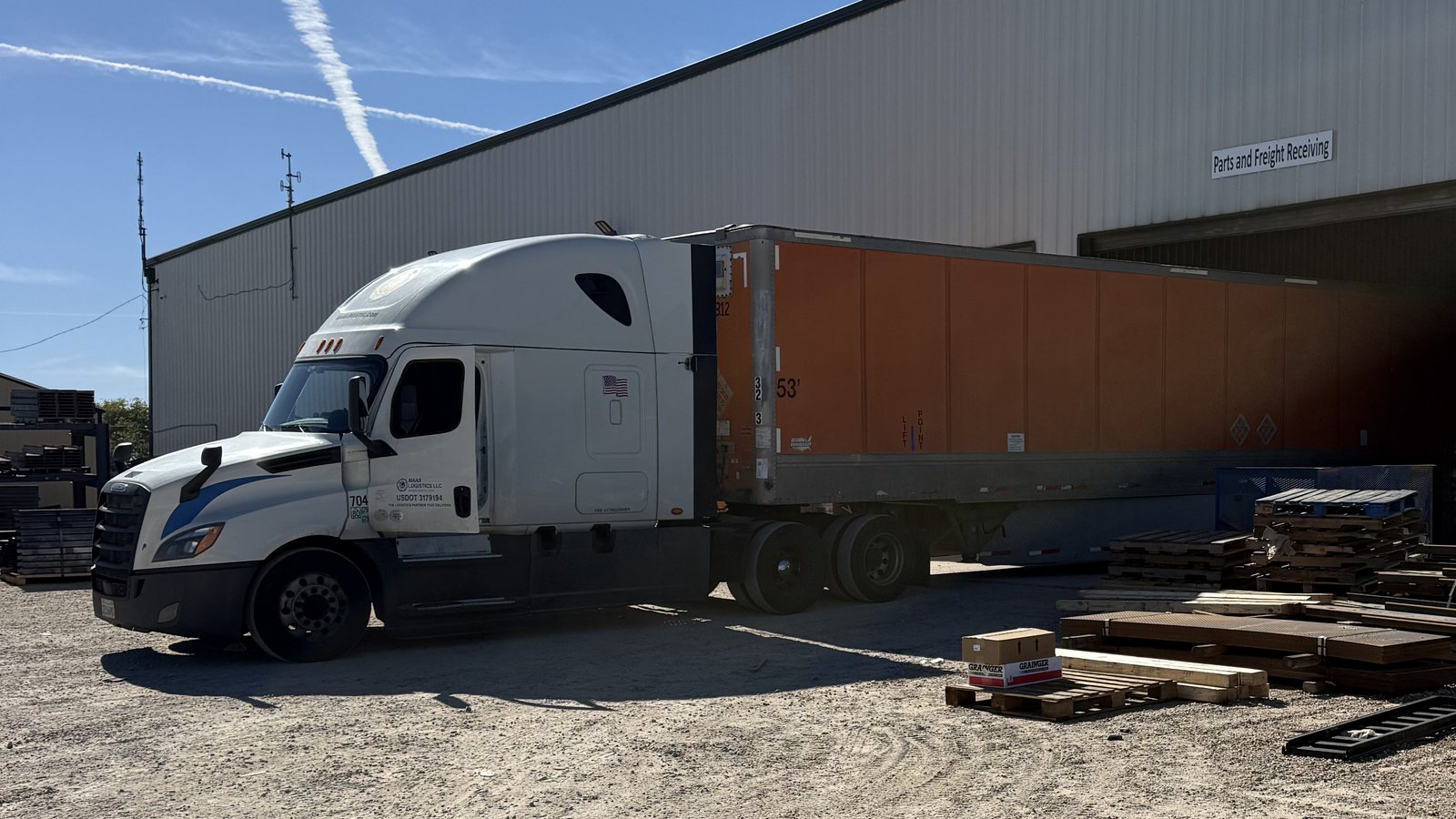
Quick answer: pallet counts for a 53-foot trailer
Here's the cheat sheet for the most common US pallet sizes in a standard 53-foot dry van. Every number assumes a single layer on the floor, pallets that don't overhang, and a typical van interior of roughly 52½ feet long and a little over 8 feet wide.
| Pallet size | Loading pattern | Pallets per row | Rows | Single-stacked total |
|---|---|---|---|---|
| 48" x 40" (standard) | Straight (48" side runs front to back) | 2 | 13 | 26 |
| 48" x 40" (standard) | Turned (40" side runs front to back) | 2 | 15 | 30 |
| 48" x 40" (standard) | Pinwheel (mix of straight and turned) | 2 | varies | about 28–30 |
| 48" x 48" | Straight | 2 | 13 | 26 |
| 42" x 42" | Straight | 2 | 15 | 30 |
Double-stacked, those floor counts double (52 for straight-loaded standard pallets, 60 for turned), but only when the product and pallets are built to carry the load above them and the total weight stays legal.
Where the 26 and 30 come from
Nothing about those numbers is magic. It's just tape-measure math.
The 48" x 40" pallet is the most common pallet in the United States. Pallet industry surveys by the National Wooden Pallet & Container Association and Virginia Tech have found it is by far the most produced standard size, and most grocery, beverage and consumer-goods freight in DFW moves on it.
A 53-foot dry van is 53 feet long on the outside. Inside, after the nose wall and the rear door frame, you usually get about 52½ feet (roughly 630 inches) of floor. Federal rules cap trailer width at 102 inches on the National Network, and the walls take a few inches, so inside width usually lands around 98 to 101 inches, depending on the trailer.
Straight loading. Put the 48-inch side running front to back and the 40-inch side across. Two pallets side by side take 80 inches of width, which fits easily. Each row uses 48 inches of length, so 13 rows take 624 inches, or 52 feet. That's 13 rows x 2 = 26 pallets, with about 6 inches to spare.
Turned loading. Turn the pallets so the 40-inch side runs front to back and the 48-inch side goes across. Two across now take 96 inches of width. That works only if the trailer's inside width leaves room for a forklift to set them without scraping the walls. Each row uses only 40 inches of length, so 15 rows take 600 inches (50 feet). That's 15 rows x 2 = 30 pallets, with room to spare at the doors.
Pinwheel loading. Some shippers alternate straight and turned pallets in a pattern to fill odd-sized gaps. It usually lands between 28 and 30, depending on the trailer and the forklift driver.
The point: if you tell a carrier "26 pallets" or "30 pallets," we can picture the load. If you say "a full truck," we can't.
Weight usually runs out before floor space
The pallet count tells you whether the freight fits. Weight tells you whether it's legal.
Under federal rules (23 CFR 658.17), a truck on the Interstate System is limited to 80,000 pounds gross vehicle weight, 20,000 pounds on a single axle and 34,000 pounds on a tandem axle group, with the federal bridge formula on top. The 80,000 pounds covers everything: tractor, trailer, fuel, driver and your freight.
Once you subtract the truck, a standard 53-foot dry van combination typically nets about 42,000 to 45,000 pounds of payload. The exact number depends on the tractor, the fuel on board and the axle setup. A reefer trailer is heavier because of the refrigeration unit and insulation, so its payload is usually a couple of thousand pounds lower.
Run the math backward and you can see where the trouble starts:
- 26 pallets at 45,000 lb averages about 1,730 lb per pallet.
- 30 pallets at 45,000 lb averages about 1,500 lb per pallet.
- Double-stacking to 52 pallets at the same weight averages only about 865 lb per pallet.
Carriers call it "cubing out" when light freight fills the trailer's space before it hits the weight limit (think paper towels, foam or empty packaging). "Weighing out" is the opposite: dense freight like canned goods, beverages, tile or metal parts hits the weight limit with floor space left over. A load of bottled water can weigh out with the back third of the trailer empty, and that's normal.
Gross weight isn't the only limit: axle weights matter
A truck can be under 80,000 pounds and still be overweight on an axle. If heavy pallets are all jammed in the nose of the trailer, the drive axles can go over 34,000 pounds even when the total is fine. If they're all at the back, the trailer tandems can.
That's why heavy loads should be spread along the floor, not piled at one end. Drivers can slide the trailer tandems to shift some weight between the drive and trailer axles, but sliding only helps so much. A load that's badly placed at the dock is a load that gets reworked at the scale.
If you know your freight is heavy, tell the carrier the total weight and the per-pallet weight when you ask for a quote, and let them know if certain pallets are much heavier than others.
Keeping the load in place
A full trailer of pallets still has to survive braking, ramps and DFW potholes. Federal cargo securement rules (49 CFR 393.100 and 393.106) require cargo to be contained, immobilized or secured so it can't shift enough to affect the truck's stability. In a dry van that usually means some combination of:
- Tight loading. Pallets loaded snug against each other and against the nose wall shift less.
- Load bars or straps across the trailer behind the last row, and at any gap in the middle of the load.
- Dunnage or airbags to fill voids between pallets or at the doors.
- Good packaging. Stretch wrap that holds the boxes to the pallet, corner boards on tall loads, and pallets that aren't broken.
A pallet that wasn't built to travel is one of the most common sources of damage, and no amount of careful driving fixes it. If your loads ship with gaps, say so at quote time so the carrier shows up with the right securement. If damage does happen, our freight claim guide walks through what to document.
Double-stacking: when it works and when it doesn't
Double-stacking is how shippers fit 52 to 60 pallets in a 53-foot van, and it can cut the number of trucks you need. It only works when:
- The product is stackable. Ask your packaging team, not your forklift driver. Crushed bottom layers are a common claim.
- The pallets are rated for it. A weak top-layer pallet can punch through the boxes underneath.
- There's height. Many 53-foot vans give you about 9 feet inside, a bit less at the door frame. Two 48-inch-tall pallets can fit. Two 60-inch-tall pallets won't.
- The weight still works. Double the pallets usually means half the weight per pallet, as the math above shows.
When you request a quote, say clearly whether freight is stackable or non-stackable. It changes how the load is planned.
Reefer loads: fewer surprises if you plan for airflow
Refrigerated trailers are also 53 feet long, but the refrigeration unit and the thicker insulated walls usually leave a little less room inside than a dry van, especially in width. Standard 48" x 40" pallets loaded straight typically still fit 26 across the floor. Turned loading can be tight in some reefers, so ask before you plan on 30.
Airflow matters as much as space. Cold air from the unit travels along the ceiling to the back of the trailer and returns along the floor to the front. To keep product at temperature:
- Don't block the return air at the front of the trailer. Leave the bulkhead area clear.
- Keep loads below the top of the air chute or the ceiling clearance your carrier gives you.
- Pre-cool the product, not just the trailer. A reefer holds temperature well, but it's not designed to cool a warm load fast.
- Put the exact temperature on the bill of lading (for example, 34°F continuous or 0°F) and confirm it with the carrier at booking.
If you ship food, the FDA's sanitary transportation rule sets expectations for shippers and carriers. Our FSMA guide covers the basics, and our refrigerated trucking page explains how we handle reefer freight from DFW.
When you don't need a full 53-foot trailer
Not every order needs the whole box. Some rough guidelines:
- About 6 to 18 pallets: often a fit for partial truckload, priced on the space and weight you use rather than freight class.
- More than about 12 pallets or 15,000 pounds: full truckload is often faster and cheaper per pound than LTL, with no terminal handling.
- Close to a full floor (two dozen or more standard pallets), or a load near the weight limit: that's full truckload territory.
Our FTL vs LTL vs partial guide explains the trade-offs in more detail. If you're not sure, send the pallet count and weight, and we'll tell you which mode makes sense.
What to send for an accurate truckload quote
Today's market makes this more important. This week FreightWaves reported tender rejections at roughly double last year's level, so loads with missing details are easier for carriers to turn down. A complete request gets a faster, firmer answer. Here's what to include on our quote form:
- Origin and destination with ZIP codes (for example, a Garland or Fort Worth DC to a receiver in Atlanta or Phoenix).
- Pickup date and window, plus the delivery appointment if you have one.
- Equipment: 53-foot dry van or reefer. For reefer, the exact temperature and whether it's continuous or cycle.
- Pallet count and pallet size (for example, 26 x 48" x 40").
- Stackable or non-stackable.
- Total weight, and the heaviest pallet if some are much heavier than others.
- Commodity in plain words (for example, "canned vegetables" or "packaged frozen chicken").
- Dock details: live load or preloaded trailer, appointment hours, and whether the receiver is a lumper facility.
- Anything special: load bars, food-grade trailer, seal requirements, or a high-value load.
Two notes from a carrier. First, rates are built from the lane, the market, fuel and the details above, so we don't publish a rate card. Our how freight quotes are priced and fuel surcharge guides explain the parts. For a step-by-step walkthrough of the request itself, see our DFW full truckload quote guide. Second, detention happens when a truck waits. If your dock runs behind, our detention guide shows how shippers cut wait times.
Common pallet-count mistakes that cost shippers money
- Quoting "full truck" without a count or weight. The carrier has to guess, and a guess can mean a re-quote or a truck that can't legally take the load.
- Forgetting overhang. A pallet with boxes hanging over the edge may not load two across. A 48" x 40" pallet with 2 inches of overhang on each side is really 52" x 44".
- Mixing pallet sizes without saying so. A few 48" x 48" pallets in a 48" x 40" load change the pattern.
- Calling freight stackable when it isn't. Crushed product on the bottom row costs more than a second truck.
- Heavy freight all at one end. Expect a reload or a fine at the scale.
- Leaving out reefer settings. "Keep cold" isn't a temperature.
How Maas handles your pallets
We're an asset-based carrier: the truck that picks up your 26 pallets in DFW is a Maas truck with a Maas driver, and we never re-broker your load to someone you haven't vetted. Our fleet runs 2020–2025 Freightliner Cascadias pulling 53-foot dry vans and reefers out of Melissa, Texas, across all 48 states, with 24/7 dispatch at (916) 770-7323. If you're comparing carriers, our asset-based carrier vs freight broker guide and carrier vetting checklist explain what to check, and our safety page shows our record (USDOT 3179194, Satisfactory safety rating).
Planning freight before the holidays or into your 2027 bid? Our peak season shipping guide and truckload RFP guide cover timing and contracts. For regular freight out of North Texas, see our Dallas–Fort Worth freight shipping lane page and our Texas freight shipping page, and catch this week's market update in today's trucking news roundup.
Drivers and owner-operators: we're hiring CDL-A company drivers (50+ CPM dry van, 60+ CPM reefer; 23+ with 3 years of experience) and leasing on owner-operators at 87–90% of gross with non-forced dispatch.
FAQ
How many pallets fit in a 53-foot trailer?
A 53-foot dry van fits 26 standard 48" x 40" pallets loaded straight and single-stacked, and up to 30 when the pallets are turned sideways and the trailer is wide enough. Double-stacking can take that to 52 or 60, but only if the freight is stackable and stays under the legal weight.
How much weight can a 53-foot trailer carry?
Federal rules limit a truck on the Interstate System to 80,000 pounds gross, including the tractor, trailer and fuel. That usually leaves about 42,000 to 45,000 pounds of payload in a standard 53-foot dry van, and a little less in a reefer because the trailer weighs more.
How many pallets fit in a 53-foot reefer?
Usually 26 standard 48" x 40" pallets loaded straight. Reefers are slightly narrower inside than dry vans, so turned loading to 30 may not fit in every trailer. Leave the front clear for return air and confirm the temperature with the carrier.
What's the difference between cubing out and weighing out?
A load "cubes out" when light freight fills the trailer before it reaches the weight limit. It "weighs out" when heavy freight reaches the legal weight with floor space left over. Both are normal; the carrier just needs your pallet count and weight to plan.
How many pallets is a full truckload versus a partial?
As a rough guide, close to a full floor (two dozen or more standard pallets) or a load near the weight limit is full truckload territory. Roughly 6 to 18 pallets often fits partial truckload, and over about 12 pallets or 15,000 pounds full truckload often beats LTL.
What information do I need to get a truckload quote?
Send origin and destination ZIP codes, pickup and delivery dates, equipment (dry van or reefer and temperature), pallet count and size, whether it's stackable, total weight, commodity and dock details. A complete request gets a faster, firmer answer. Request a quote.
Sources
- 23 CFR 658.17, Weight (eCFR) — 80,000 lb gross, 20,000 lb single axle, 34,000 lb tandem axle and the bridge formula: https://www.ecfr.gov/current/title-23/chapter-I/subchapter-G/part-658/section-658.17
- FHWA, Commercial Vehicle Size and Weight Program — 102-inch width, 48-foot minimum semitrailer length on the National Network: https://ops.fhwa.dot.gov/freight/sw/overview/index.htm
- 49 CFR 393.100 and 393.106 (eCFR) — cargo securement: https://www.ecfr.gov/current/title-49/subtitle-B/chapter-III/subchapter-B/part-393/subpart-I
- Gerber, Horvath, Araman and Gething, "Investigation of New and Recovered Wood Shipping Platforms in the United States" (Virginia Tech / NWPCA / USDA Forest Service) — 48" x 40" as the dominant standard pallet size: https://www.srs.fs.usda.gov/pubs/ja/2020/ja_2020_araman_001.pdf
- FreightWaves, Nov. 16, 2026 — tender rejections: https://www.freightwaves.com/news/50-spike-spot-rates-soar-earlier-than-expected