
Trucking News
Freight Gets a Short Breather After Thanksgiving Before Capacity Tightens Again for Christmas
· By Maas Logistics Editorial Team · 8 min read
Saturday-after-Thanksgiving edition from Melissa, Texas: holiday routing limits should ease briefly before Christmas squeezes truck capacity again, leaving shippers a short early-December window. Also today: the dyed-diesel deadline, DOT fraud referrals, unreported Texas bridge strikes and a proposed parking restriction alongside DFW cargo-theft risk. Moving freight next week? Request a freight quote.
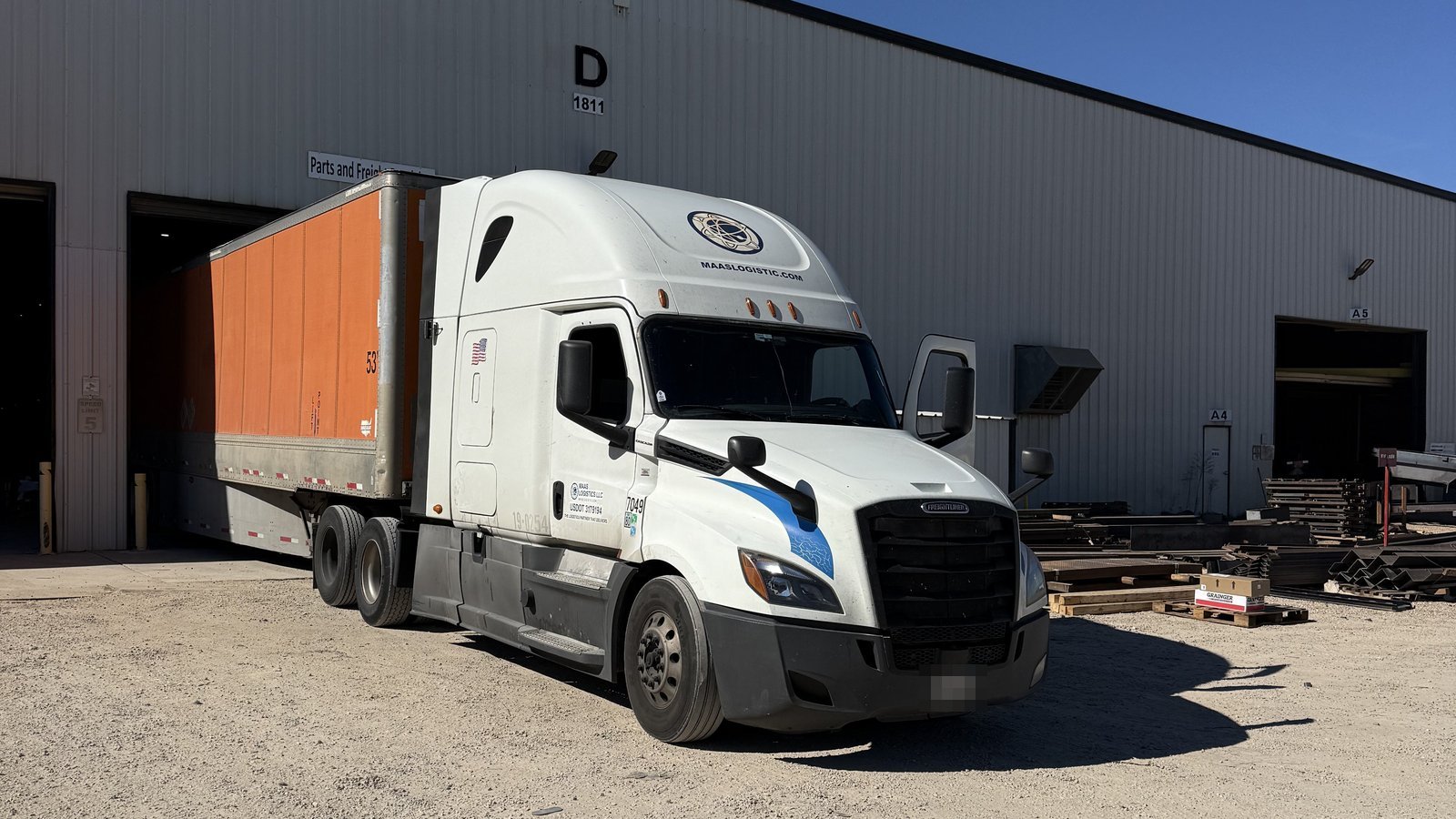
The early-December capacity window is short
FreightWaves (capacity) reported Nov. 24 that national truckload tender rejections rose from 12.59% to 13.52% between Nov. 17 and Nov. 23. Tendered volume was about 6.6% above last year, but accepted contract volume was about 5% lower. Julie Van de Kamp put it plainly: "This is still a capacity story, not a demand story." The distinction matters: more freight offered does not mean more freight actually moving under contract.
Van de Kamp said drivers heading home for the holiday and carriers limiting how far loads go restrict holiday routing, including keeping loads within half the country. Those limits ease after Thanksgiving, then tighten again before Christmas. Her advice: tender early, confirm trucks directly with primary carriers, especially on reefer lanes, and arrange backups before a load works its way down the routing guide. That is a short opening, not a promise that every lane gets easy.
The Trucker (RXO Curve) reported Nov. 27 that RXO's Curve forecast marked a tenth straight quarter of year-over-year spot rate inflation excluding fuel. Its index ended the third quarter at 37.9%, the highest since 2021, versus 32.4% in the second quarter. Through Nov. 13, the fourth quarter was tracking below the third but still well into inflationary territory. RXO linked that to capacity attrition from federal regulation enforcement and rising carrier costs. Jared Weisfeld said: "The market remains highly susceptible to increases in demand."
FreightWaves (rail) reported U.S. rail traffic for the week ending Nov. 21 rose 4.7% year over year, with containers and trailers up 8.3%, pointing to healthy import and holiday consumer shipping. Overdrive, citing DAT, said each of the last ten Novembers reached its high after Nov. 22. This year has 29 days between Thanksgiving and Christmas, one more than 2025: Thanksgiving weekend plus three full December weekends, with Christmas on Friday. From Melissa, the practical call is to move what can move in the first two weeks of December; DFW retail replenishment and food freight compete for the same trucks before the cutoff. See Friday’s Black Friday roundup for that separate lead.
What it means for Texas shippers: book next week's dry van and reefer loads now, confirm receiver appointments in writing and keep dock time short. Use the peak-season shipping guide, detention guide and fuel surcharge guide to sort out the details. Request a quote rather than assuming a truck is available.
- Source: FreightWaves (capacity)
- Source: The Trucker (RXO Curve)
- Source: FreightWaves (rail)
- Source: Overdrive
Federal dyed-diesel penalty relief ends Dec. 31
Big Rig Report (dyed diesel) explained Nov. 25 that Executive Order 14435, signed Oct. 5, directed Treasury to defer federal excise tax on dyed diesel used on highways and drop penalties through the end of 2026. On Oct. 14, the IRS said it would not penalize highway use, backdated to Oct. 1. The tax was deferred, not canceled; Transport Topics put that federal tax at 24.4 cents a gallon, as covered in the report.
The calendar matters. ‘Nontaxable use only’ pump signs must return Jan. 1, 2027. The IRS had not announced a grace period for dye remaining in tanks after Dec. 31. Federal relief also never covered state fuel taxes or state penalties. Texas's disaster proclamation had no end date, but the 20-cent state tax was still owed for highway use.
The International Fuel Tax Association warned that a truck legally using dyed fuel in one state can face a penalty after crossing into another. Most states still expect the gallons reported for fuel-use tax. OTR News flagged the Dec. 31 deadline Nov. 27 and reported EIA's Nov. 24 diesel figure of $5.695 a gallon, a fourth weekly decline but still $1.86 above a year earlier. A pump price and a tax obligation are separate parts of the fuel bill.
What it means for owner-operators: if there is red fuel in your tanks, plan to run it down before Jan. 1, check every state on your route and keep receipts clean for IFTA. Do not treat federal relief as permission in every state. The owner-operator cost-per-mile guide helps organize costs; owner-operators can review leasing on with Maas.
- Source: Big Rig Report (dyed diesel)
- Source: OTR News
DOT watchdog refers 20 motor-carrier cases for prosecution
The Trucker (DOT OIG) reported Nov. 26 that DOT's Office of Inspector General listed 20 motor-carrier cases referred for criminal or civil prosecution between April 1 and Sept. 30, 2026. Six involved falsified or altered inspection records and six involved fraudulent registrations or reincarnated ‘chameleon’ carriers. The rest covered attempted bribery, CDL violations, drug and alcohol programs and driver qualifications, one each, plus four other matters.
The OIG separately reported five workforce-protection fraud referrals: three involving carriers and two involving freight forwarders or brokers. One highlighted Louisiana CDL bribery scheme ran from 2020 to 2024 and allowed more than 100 people to obtain CDLs without meeting requirements. A referral is a referral, not a conviction; the report should be read without turning allegations into a verdict against anyone.
FMCSA expanded its online complaint center earlier this month. A bill making the federal CDL fraud tip line permanent was referred to the House Transportation and Infrastructure Committee Nov. 12. Tips can go to the DOT OIG hotline or 800-424-9071. Shippers can check a carrier's public USDOT record before tendering, just as drivers can before accepting a seat.
What it means for CDL drivers: look up the USDOT number on FMCSA’s public site, check the safety rating and how long authority has been active, and expect a proper driver qualification file. Read how to vet a carrier and the carrier-vetting checklist. Maas's record is public under USDOT 3179194, with a Satisfactory safety rating. Apply as a company driver.
- Source: The Trucker (DOT OIG)
Unreported Texas bridge strikes can come back as a repair bill
Big Rig Report (TxDOT bridge strikes), citing TxDOT's Nov. 17 release and CDLLife, reported inspectors found evidence of 30 unreported bridge strikes in 2025 and 61 more so far in 2026. TxDOT estimated about 45 strikes went unreported in 2025. The Fort Worth area led Texas with eight reported strikes last year. Those discovered marks and estimates are not the same count as reported incidents.
Houston's Houston Avenue bridge near I-10 has been hit six times this year and 16 times since January 2025. Demolition is tentatively scheduled to begin in early 2027 and finish around mid-2028, with the road redesigned to pass under I-10. That is a planned project, not a reason to ignore today's clearance.
TxDOT said most strikes happen when a truck or load exceeds the clearance, particularly off an approved route or without a permit. Loads over legal size or weight need a Texas DMV oversize/overweight permit. Some districts use over-height warnings; the Odessa area has systems at 19 structures. TxDOT can file a liability claim for repairs when a driver is responsible. Reporting a strike promptly matters for everyone approaching the structure afterward.
What it means for CDL drivers: know your measured height, stay on truck routes and treat low-clearance signs as hard limits. Report any strike right away. Work through the CDL pre-trip inspection checklist before departure; drivers looking for a seat can apply as a company driver.
Texas parking proposal meets an already risky DFW parking picture
Big Rig Report (Texas truck parking bill) reported Nov. 24 that House Bill 553, filed for the session opening Jan. 12, would replace the current 10 p.m.–6 a.m. restriction with an all-hours ban on parked trucks on posted residential streets. It would reach streets within 1,000 feet of retail areas, let cities and counties post signs without the current 25% resident petition and allow immediate towing. As filed, it would take effect Sept. 1, 2027. It is a proposal, not law.
Two exceptions would remain: a rest break of up to two hours with the driver in the cab, and up to two hours for a delivery or job in the subdivision. Drivers should not mistake the proposed rules for current rules, or assume those exceptions create an overnight parking option.
Freight Wire (Overhaul cargo theft), reporting on Overhaul's July–September figures, said DFW accounted for nearly one in five U.S. cargo thefts and 80.4% of Texas thefts. Incidents along southern Dallas's truck-stop-lined I-20 stretch rose each quarter this year. Truck stops and fuel stations made up 20.7% of incidents, versus 7.3%; noon to 6 p.m. accounted for 32%, and Friday 20.5%.
Overhaul's Ronald Greene pointed to well-lit, busy parking, good trailer locks and watching the rig during breaks as ways to make a load a harder target. Barry Conlon said a similar pattern last year was followed by more holiday-season theft. Parking planning belongs alongside the delivery appointment, not at the bottom of the list when the clock is nearly gone.
What it means for drivers and owner-operators: plan the stop before your clock runs short, choose lit, busy lots, lock and seal the trailer and keep an eye on it. Parking is getting harder and riskier at the same time. Include the stop in your cost-per-mile planning; owner-operators can review Maas leasing information.
Saturday note
The weekend after Thanksgiving is when held freight lines up for Monday. Drivers: plan fuel and parking early this weekend. Shippers: the early-December window is short, so tender early and confirm appointments in writing.
Catch up with Friday’s roundup, Thursday’s roundup and the news index.
Changing carriers? Read the Nov. 27 driver qualification file guide before gathering your paperwork.
Running with Maas
Maas Logistics LLC is an asset-based dry van and reefer carrier in Melissa, Texas (USDOT 3179194, founded 2018, Satisfactory safety rating, 18 trucks). We haul our own loads with our own trucks and never re-broker.
Company drivers: 50+ CPM dry van / 60+ CPM reefer, weekly direct deposit, drivers 23+ with 3 years experience. Owner-operators: 87–90% of gross, non-forced dispatch, weekly pay (1099).
Office: 1817 Miller Rd #5, Melissa, TX 75454 · (916) 770-7323.
Drive or ship with Maas
CDL-A drivers: 50+ CPM dry van / 60+ CPM reefer, weekly direct deposit — apply as a company driver.
Owner-operators: 87–90% of gross, non-forced dispatch.
Shipping dry van or reefer freight in the early-December window or into 2027? Get a quote from an asset-based carrier that never re-brokers.
Sources: FreightWaves (capacity); The Trucker (RXO Curve); FreightWaves (rail); Overdrive; Big Rig Report (dyed diesel); OTR News; The Trucker (DOT OIG); Big Rig Report (TxDOT bridge strikes); Big Rig Report (Texas truck parking bill); Freight Wire (Overhaul cargo theft).
Running with Maas
Hiring CDL-A company drivers: company driver openings. Owner-operators: lease on with Maas. Need a truck: get a freight quote.
Maas Logistics LLC | 1817 Miller Rd #5, Melissa, TX 75454 | (916) 770-7323 | dispatch@maaslogistic.com
Dallas–Fort Worth | USDOT 3179194
The Logistics Partner that Delivers.