
Maas Logistics Dispatch · Shipper Guides
What Is a Bill of Lading? What Truckload Shippers Should Put on the BOL, Who Signs It, and How It Protects Your Freight
· By Maas Logistics Dispatch
Every truckload starts and ends with one document: the bill of lading. It tells the driver what they are picking up, tells the receiver what should come off the trailer, and becomes Exhibit A if anything goes wrong. A missing pallet count or a blank seal line can turn a routine delivery into a freight claim nobody can win. This guide explains what a bill of lading is, what federal rules say it must include, the difference between straight and order bills, how "shipper's load and count" works, what to put on a reefer BOL, and a short checklist your dock team can use on every load.
It is written by Maas Logistics LLC, an asset-based dry van and reefer carrier in Melissa, Texas, on the north side of Dallas–Fort Worth. We have hauled full truckload freight across the lower 48 states since 2018 with our own trucks and our own drivers, and we never re-broker a load. This is a practical guide from a carrier, not legal advice. Your contracts, your attorney and the regulations cited below are the authorities on your situation.
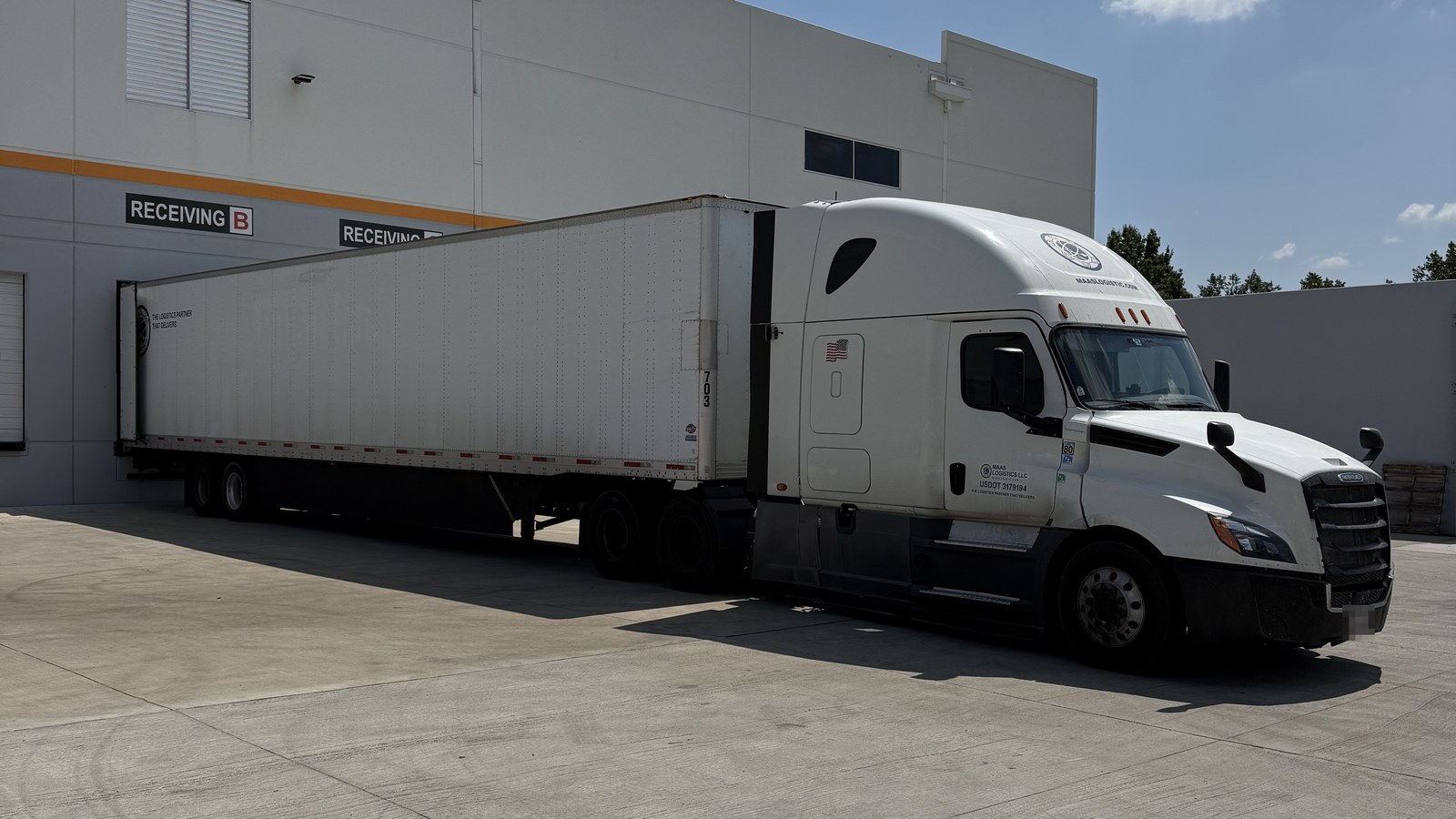
What is a bill of lading?
A bill of lading (often shortened to BOL or B/L) is the shipping document a carrier issues when it takes your freight. In truckload shipping it does three jobs at once:
- Receipt. It records that the carrier received a certain number of pieces or pallets, described a certain way, from a certain shipper, on a certain day.
- Evidence of the contract of carriage. It names who is shipping, who is receiving, where the load is going and under what terms. If you have a signed transportation agreement with your carrier, the BOL works alongside it.
- Document of title, in some cases. An "order" bill of lading can control who is entitled to the goods. Most domestic truckload freight moves on a "straight" bill, which does not (more on that below).
Under 49 U.S.C. 14706, a motor carrier must issue a receipt or bill of lading for property it receives for interstate transportation and is liable for actual loss or injury to that property. The statute also says failure to issue a receipt or bill of lading does not affect the carrier's liability. The paperwork doesn't create the carrier's responsibility, but it is the best proof of what the carrier actually received.
What must a bill of lading include?
The federal minimum is short. Under 49 CFR 373.101, a for-hire motor carrier's receipt or bill of lading for interstate freight must show:
- the names of the consignor (shipper) and consignee (receiver)
- the origin and destination points
- the number of packages
- a description of the freight
- the weight, volume or measurement of the freight, if that is used to rate it
The carrier must also keep a record of this information under 49 CFR part 379, whose retention schedule lists copies of bills of lading for one year.
That federal list is the floor, not the ceiling. In real-world dry van and reefer freight, a clean BOL carries more detail so the driver, the dispatcher and the receiver are all looking at the same facts.
| BOL field | Why it matters | Federal minimum? |
|---|---|---|
| Shipper and consignee names and addresses | Who handed over the freight and who signs for it | Yes (names; origin and destination) |
| PO, order or appointment numbers | Receivers often won't unload a truck that can't match a PO | No, but most receivers require it |
| Number of pallets or pieces | The most disputed number in shortage claims | Yes (number of packages) |
| Freight description | Prevents misdelivery and supports a damage claim | Yes |
| Weight | Legal axle and gross weights; weight-based rating | Yes, if used to rate the freight |
| Seal number | Proves the trailer stayed closed between docks | No, strongly recommended |
| Reefer setpoint and unit mode | Tells the driver exactly how to run the unit | No, essential for reefer |
| Loading method (shipper load and count or driver count) | Changes who is responsible for the count (see below) | No |
| Signatures and dates | Turn the document into proof at pickup and delivery | No, but unsigned BOLs prove little |
If you're still planning how much freight goes on the truck, our guide to how many pallets fit in a 53-foot trailer helps you get the pallet count right before it goes on the BOL.
Straight bill of lading vs. order bill of lading
The Federal Bills of Lading Act (49 U.S.C. 80103) sorts bills into two types:
- Negotiable ("order") bill of lading. The bill states that the goods are to be delivered "to the order of" a consignee and doesn't say on its face that it is non-negotiable. Whoever properly holds the bill can claim the goods. Order bills are common in international trade and in sales where payment is tied to the document.
- Nonnegotiable ("straight") bill of lading. The bill states that the goods are to be delivered to a named consignee. Endorsing it to someone else doesn't make it negotiable. The statute requires a common carrier issuing a nonnegotiable bill to mark it "nonnegotiable" or "not negotiable."
For a typical full truckload from a Texas plant or distribution center to a customer's warehouse, you'll almost always use a straight bill of lading. The receiver named on the bill signs for the freight, and that's it.
"Shipper's load and count" and who is responsible for what
On a live load at a shipper's dock, the shipper's crew usually loads the trailer while the driver waits outside or in the cab. Many docks don't let drivers onto the floor at all. In that case, the driver can't verify what went into the trailer, and the BOL should say so.
The Federal Bills of Lading Act addresses this directly. Under 49 U.S.C. 80113, a carrier is generally liable when the goods it receives don't match the description on the bill. But the carrier is not liable for that mismatch when the shipper loaded the goods and the bill is qualified with words such as "shipper's weight, load, and count" or "said to contain." The carrier is also not liable for damage caused by improper loading when the shipper loaded the goods and the bill carries "shipper's weight, load, and count" or similar wording.
The flip side matters too: when the carrier loads the goods, the carrier must count the packages, and writing "shipper's load and count" on the bill has no effect except for freight concealed inside packages.
What this means at your dock:
- If your crew loads and the driver can't watch, expect "SLC" or "shipper's load and count" on the BOL. That's normal and honest.
- If you want a driver count, let the driver watch (if your safety rules allow) and give them time. A driver-verified count is stronger proof in a shortage dispute.
- On a drop trailer, the seal number and your own loading records carry the weight.
- Load securely. Load bars and straps are cheap compared with a rejected load.
What to put on a reefer bill of lading
Temperature-controlled loads need everything above plus clear temperature instructions. A reefer BOL that says only "keep cold" invites a dispute. Write down:
- The setpoint in degrees Fahrenheit, for example "Set reefer at 34°F."
- The unit mode: continuous (the unit runs all the time) or start/stop (cycle). Many fresh products need continuous airflow; your product spec decides.
- Whether the trailer must be pre-cooled before loading.
- Product temperature at loading if you take pulp or product temperatures, so there's a baseline if the receiver questions it.
The written setpoint on the BOL is what the driver will run. For the federal food-safety side of refrigerated transport, see our guide to FSMA sanitary transportation compliance, and for how we handle temperature-controlled freight, see refrigerated trucking.
Seals: a small number with big consequences
A trailer seal is a numbered tag or bolt that shows whether the doors were opened between pickup and delivery. For full truckload freight:
- Apply the seal at your dock after loading, and write the seal number on the BOL before the driver signs.
- The driver should check that the number on the seal matches the number on the paperwork.
- The receiver should check the seal is intact and the number matches before cutting it, and note any mismatch on the delivery receipt.
An intact seal with a short count points back toward loading; a broken or missing seal points toward transit. The seal number on the BOL is how you prove which it was.
At delivery: proof of delivery and exceptions
When the load arrives, the receiver signs the BOL or delivery receipt, and that signed copy becomes your proof of delivery (POD). This is the moment that decides most claims.
- Count and inspect before signing. Receivers should check pallet count, visible damage and, on reefer loads, temperature before the driver leaves.
- Write exceptions on the paperwork. "2 pallets short," "1 pallet crushed, top layer," "seal number does not match." A clean signature with no notes is very hard to argue with later.
- Take photos. Photos of the open trailer, the seal and any damage, with the BOL in frame, are worth more than a long email a week later.
If something does go wrong, federal law sets minimum windows. Under 49 U.S.C. 14706, a carrier may not give you less than 9 months to file a claim or less than 2 years to bring a civil action (counted from when the carrier gives written notice that it has disallowed the claim). Our step-by-step guide on how to file a freight claim walks through the claim package, and a well-written BOL is the first document in it.
The most common bill of lading mistakes
From the dispatch side, these are the BOL problems we see most:
- No real pallet count. "1 load" isn't a count; write the number of pallets.
- Vague description. "General merchandise" on a full truckload makes a damage claim harder to prove.
- No PO or reference number. The receiver can't match the delivery and the truck sits. See our guide to reducing detention at your dock.
- Blank seal line. If you sealed the trailer, record the number.
- No reefer setpoint, or no unit mode. Always write °F and continuous or start/stop.
- Old template, wrong consignee. Copying last month's BOL is how freight ends up at a closed warehouse.
- Missing signatures or dates. An unsigned BOL proves very little.
How bills of lading work with an asset-based carrier
On a brokered load, the company you booked with and the company whose truck shows up can be different businesses, and the carrier on your BOL may not be the one you thought you hired. When you ship with Maas Logistics, the carrier named on your bill of lading is the carrier hauling your freight: our own trucks, our own drivers, never re-brokered. Read more in our guide to asset-based carriers vs. freight brokers.
If you're planning holiday freight, our peak season shipping guide and DFW full truckload quote guide cover timing and what to send us for a fast quote. For this week's port and capacity news, see our Nov. 21 trucking news briefing.
Quick bill of lading checklist
- Names, addresses, PO and appointment numbers match what the receiver expects.
- Pallet count written as a number, with a specific description and weight.
- Seal number on the BOL matches the seal on the doors.
- Reefer: setpoint in °F, continuous or start/stop, pre-cool noted.
- Loading method noted (shipper load and count or driver count).
- Shipper and driver signed and dated; you kept a copy.
Shipping or driving with Maas Logistics
Maas Logistics LLC runs dry van and reefer full truckload freight across the lower 48 states from Melissa, Texas, serving the Dallas–Fort Worth area. We hold USDOT 3179194 and a Satisfactory safety rating.
- Shippers: need an asset-based dry van or reefer carrier out of Dallas–Fort Worth that never re-brokers? Request a quote.
- Company drivers: you sign the BOL on every load, so check the count when you can, write "SLC" when you can't, match the seal and read the reefer setpoint before you leave, just like a careful pre-trip inspection. We pay 50+ CPM dry van and 60+ CPM reefer and hire drivers 23 and older with 3 years of experience. Apply as a company driver.
- Owner-operators: keep 87–90% of gross with non-forced dispatch. Lease on with Maas.
- Questions? Call 24/7 dispatch at (916) 770-7323.
FAQ
What is a bill of lading in trucking?
It's the document a carrier issues when it receives your freight. It serves as a receipt for the goods, evidence of the shipping contract and, for an order (negotiable) bill, a document of title. Federal law (49 U.S.C. 14706) requires motor carriers to issue a receipt or bill of lading for interstate freight.
What information is required on a bill of lading?
Under 49 CFR 373.101, a for-hire motor carrier's bill of lading must show the shipper and consignee names, origin and destination points, number of packages, description of the freight, and weight, volume or measurement if it's used to rate the freight. Most shippers also add PO numbers, seal numbers, special instructions and, for reefer loads, the temperature setpoint.
What is the difference between a straight and an order bill of lading?
A straight bill of lading is nonnegotiable: the goods go to the consignee named on it. An order bill of lading is negotiable: the goods are delivered "to the order of" a consignee, so whoever properly holds the bill can claim them (49 U.S.C. 80103). Most domestic truckload freight moves on straight bills.
What does "shipper's load and count" mean on a BOL?
It means the shipper loaded and counted the freight and the driver didn't verify it. Under 49 U.S.C. 80113, when the shipper loads the goods and the bill carries that wording, the carrier generally isn't liable for a mismatch between the goods and the description, or for damage caused by improper loading.
How long should a bill of lading be kept?
Under the federal records schedule in 49 CFR part 379, motor carriers keep copies of bills of lading for one year. Shippers often keep them longer because of claim windows: a carrier can't give you less than 9 months to file a claim or less than 2 years to sue after a written claim denial (49 U.S.C. 14706).
Sources: 49 CFR 373.101 (https://www.law.cornell.edu/cfr/text/49/373.101); 49 CFR Part 379, Appendix A (https://www.law.cornell.edu/cfr/text/49/appendix-A_to_part_379); 49 U.S.C. 14706 (https://www.law.cornell.edu/uscode/text/49/14706); 49 U.S.C. 80103 (https://www.law.cornell.edu/uscode/text/49/80103); 49 U.S.C. 80113 (https://www.law.cornell.edu/uscode/text/49/80113).