
Trucking News
Truck Capacity Exits at a Record Pace as Carriers Get a Peer Exchange for Uncovered Loads
· By Maas Logistics Editorial Team · 8 min read
Updated
Thursday roundup from Melissa, Texas, with a shipper lead up top and the rest leaning toward drivers and owner-operators: SONAR counts about 107,000 fewer for-hire tractors than a year ago, a new peer exchange lets carriers hand off loads they can't cover, an FMCSA Motus glitch left a Colorado owner-operator showing inactive for nearly three months, TxDOT tallies bridge strikes while lawmakers line up route and axle bills, and the Trucker Bathroom Access Act cleared a Senate committee. Shippers with dry van or reefer freight to move can request a quote from an asset-based carrier.
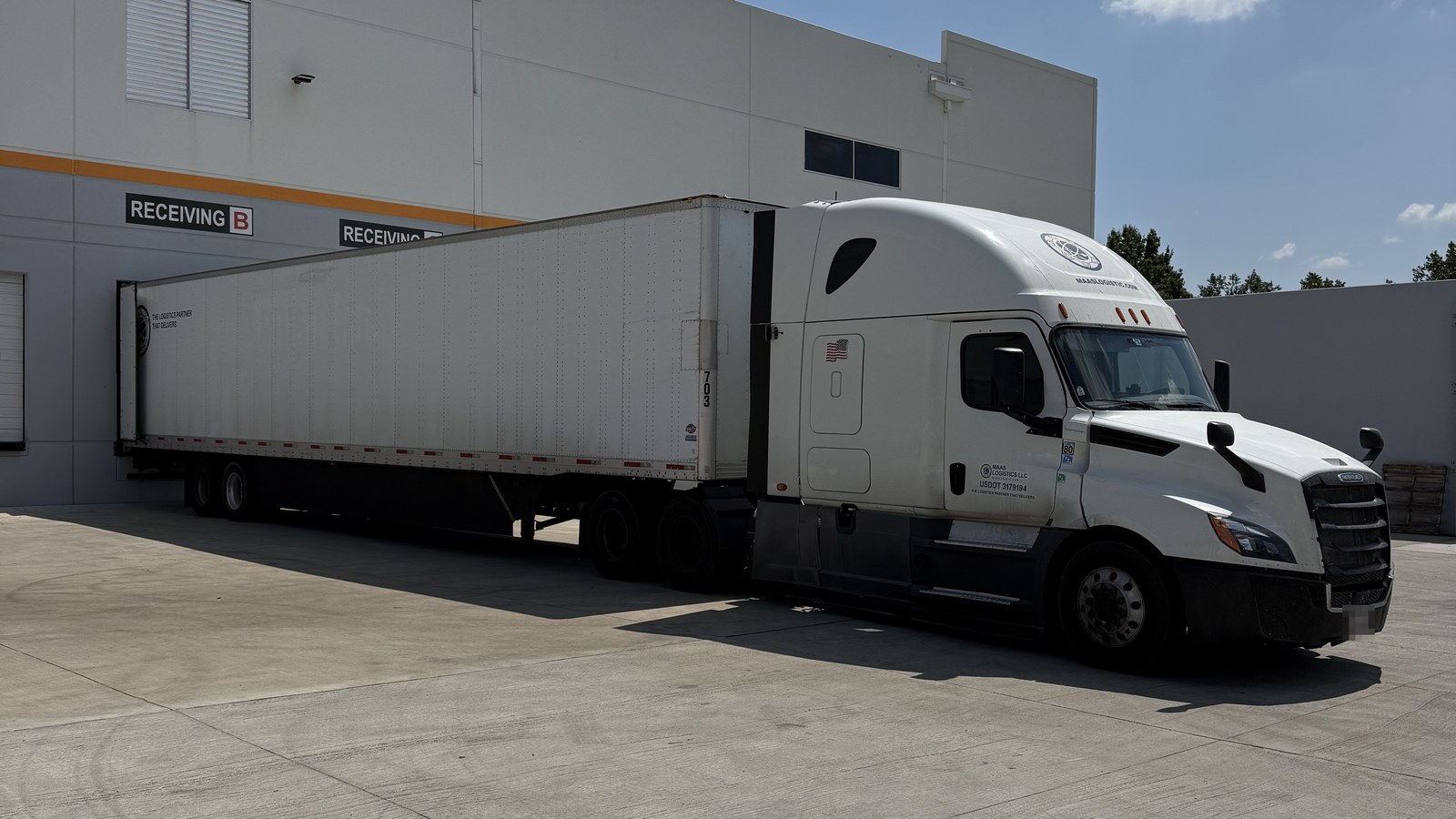
Truck capacity exits at a record pace
FreightWaves on Wednesday, Nov. 18, ran SONAR's new Sitrep, titled "The Lag Effect," and the headline number is hard to miss. SONAR counts 1,551,161 tractors in for-hire fleets, about 107,000 fewer than a year ago. Roughly 51,000 of those dropped out in a single month this summer, the biggest decline in a data series that runs back to 2008.
FreightWaves is upfront that part of the drop may be paperwork, since FMCSA's Motus registration system went live in May. But the big fleets are getting smaller too: Knight-Swift's average tractor count fell 4% year over year and Schneider's fell 8%.
Rates have finally gotten ahead of costs. SONAR's spot linehaul rate without fuel sits at $2.60 a mile, up about 49% from last year and roughly 75 cents above ATRI's 2025 industry non-fuel cost of $1.854 a mile, which itself rose 4.2% in 2025. Dry van contract base rates are at $2.88, up about 25%. The Sitrep reads the more than 1,000 logistics job cuts and 15 bankruptcy filings of the past few weeks as the bill coming due for 2023 through 2025, when the cushion between dry van contract linehaul and non-fuel cost shrank from about $1.01 a loaded mile in 2022 to about 26 cents in 2025.
The national tender rejection index reads 12.87%, but that average hides a split map. The Northwest (23.19%) and Midwest (17.55%) are tight, while Dallas (7.91%) and Houston (6.49%) are among the large markets that are still loose. Reefer rejections are running above 21%. For 2027 bids, the Sitrep's base case is dry van contract increases of about 5% to 8%, moving into double digits if capacity keeps leaving. Reefer contract base rates are up only about 8% and sit about 30 cents a mile under dry van contract. SONAR's advice: price routing guides lane by lane, not off the national index.
What it means for Texas shippers: DFW and Houston outbound look loose today, but the national fleet keeps shrinking and reefer is already tight. Build your 2027 routing guide lane by lane with dependable asset-based carriers — our truckload RFP guide walks through the bid, and Maas runs dry van trucking and refrigerated trucking out of Melissa. Yesterday's contract-rate picture is in the Nov. 18 roundup. Send your lanes for a freight quote.
Carriers get a peer exchange for loads they can't cover
FreightWaves reported Wednesday, Nov. 18, that Graypool, an Atlanta freight software company formerly known as HOPTEK, has opened Graypool Exchange. It starts with seven invitation-only founding member carriers that can pass qualified freight they can't cover directly to one another before they reject the tender.
Members decide what they offer, what they take and at what price. They work under shared commercial, data and insurance standards, with interchange agreements their insurers have approved. Only loads whose shippers allow a hand-off reach the exchange; freight a shipper requires its contracted carrier to run never goes there. Graypool says it doesn't hold the freight and doesn't broker it. In the company's release: "We don't take the load. We don't broker it. We run the floor."
SONAR numbers in the FreightWaves story show why loads slipping down a routing guide matter. Tender rejections averaged 14.5% in the third quarter, against 5.3% a year earlier, and now sit at 12.77%, the lowest since early May. SONAR's Routing Guide Premiums index shows shippers paid 9.25% more for loads accepted on the second tender and 19.84% more at the third tender or beyond.
What it means for Texas shippers: Every step a load slides down your routing guide costs real money, and carrier-to-carrier hand-offs are getting more common. Know whether your contracts allow a hand-off, and ask who will actually haul the load. Maas hauls its own freight with its own trucks and drivers — USDOT 3179194 is on every door — and never re-brokers a load. Our asset-based carrier vs. freight broker guide lays out the difference, and you can request a quote anytime.
- Source: FreightWaves (Graypool Exchange)
Motus glitch leaves an owner-operator "inactive" for nearly three months
Overdrive's Jason Cannon reported Nov. 18 on Darryl Gibbs, a Colorado owner-operator who runs Dragon Logistics out of Aurora, hauling ag and livestock. His USDOT number showed inactive in FMCSA's Motus system for almost three months, and he didn't know for close to a month — a business partner had to tell him.
Gibbs' filing service said FMCSA representatives told them the agency's systems had "stopped talking to each other" and that the number had to be linked by hand, with no timeline. All that time, brokers and shippers could see the inactive status, and a roadside inspection could have put him out of service. "I should not be penalized for FMCSA's mistake," Gibbs told Overdrive.
FMCSA didn't respond to Overdrive's request for comment, but the number was reactivated about 16 hours after Overdrive asked. Central Analysis Bureau, Overdrive's sister company, says inactivations and unexplained authority suspensions have been among the common problems since Motus debuted in May.
What it means for owner-operators: Don't wait for a broker or a partner to tell you. Look up your own USDOT and authority status every week on the public FMCSA/Motus search, keep your MCS-150 current with copies in the truck, and know who to call when something looks off. Run your numbers with our owner-operator cost-per-mile guide, or lease on with an established carrier that handles authority and compliance paperwork — Maas pays owner-operators 87–90% of gross with non-forced dispatch. The Nov. 12 roundup covered the wider wave of Motus suspensions.
- Source: Overdrive
Texas tallies bridge strikes as lawmakers line up route and axle bills
TxDOT's newsroom (Nov. 17) says the agency records dozens of bridge strikes every year and the real count is likely higher. Inspectors found 30 suspected unreported impacts in 2025 inspections and 61 so far in 2026 inspections, and TxDOT estimates around 45 strikes may have gone unreported in 2025. The Fort Worth area had the most reported strikes last year, with 8.
In Houston, the Houston Avenue bridge near I-10 has been hit six times this year and 16 times since January 2025. It's tentatively set for demolition starting in early 2027, with completion in mid-2028, so the road can run under I-10. Out west, the Odessa area has over-height detection at 19 structures. When a driver is responsible, TxDOT can pursue a liability claim. The agency's advice is plain: know your vehicle's height, get the proper permits and follow approved routes.
Land Line's Keith Goble (Nov. 18) ran down bills for the legislative session that begins Jan. 12. HB468 would require TxDOT to consult Chambers County on heavy-truck routes in unincorporated areas near the Port of Houston. HB359 would let aggregate haulers carry up to 20,000 pounds on a single axle and 34,000 on a tandem with a 15% tolerance, as long as gross weight stays at or under 80,000 pounds. TxDMV estimates that could eliminate 23,000 tolerance permits a year, while counties could lose about $38 million over five years. Land Line also covers SB166 and SB167 on overweight hazmat tankers; background is in the Nov. 18 roundup.
What it means for CDL drivers: A legal-size dry van or reefer isn't an oversize load, but low clearances still catch drivers on unfamiliar city routes. Check posted clearances, use truck-specific routing, and start every trip with a solid walk-around — our CDL pre-trip inspection checklist covers it. Maas hires company drivers at 50+ CPM dry van / 60+ CPM reefer, drivers 23+ with 3 years experience.
Trucker Bathroom Access Act clears Senate committee
Transport Topics reports the Senate Commerce, Science and Transportation Committee advanced the Trucker Bathroom Access Act on Nov. 18, five days after Sens. Lisa Blunt Rochester (D-Del.) and Deb Fischer (R-Neb.) introduced it. The bill would require businesses — shippers, receivers, warehouses and distribution centers included — to let drivers who fall under hours-of-service rules use existing customer or employee restrooms when that poses no health, safety or security risk. Nobody would have to build new restrooms, and drayage drivers are covered.
ATA's Henry Hanscom called the vote "a breakthrough" and credited ATA's Women In Motion Council. The House companion from Reps. Troy Nehls (R-Texas) and Chrissy Houlahan (D-Pa.) was approved by the House Transportation and Infrastructure Committee in May for the BUILD America 250 Act. It still needs floor votes. More of this week's driver news is in the Nov. 16 roundup.
What it means for CDL drivers and Texas shippers: This is basic dignity at the dock, and shippers and receivers don't have to wait on Congress to let a waiting driver use the restroom. Drivers working their clock can plan stops with our hours-of-service guide, and CDL-A drivers can apply as a Maas company driver.
- Source: Transport Topics
Thursday note: Thanksgiving is one week out
Thanksgiving is one week out, on Thursday, Nov. 26. Tender holiday dry van and reefer freight early and confirm receiving dock hours for the holiday week. Planning a full truckload? Our pallet guide shows how many pallets fit in a 53-foot trailer, and you can request a quote anytime.
Catch up on the week in the Nov. 18 roundup, the Nov. 17 roundup and the Nov. 16 roundup, or browse every post on the news page. Medical card coming due? Read our new guide: DOT Physical for Truck Drivers.
What it means for Texas shippers: Holiday docks close early and fill fast. Send pallet count, weight, dock hours and reefer temperature with the tender so the load is ready to book.
About Maas Logistics
Maas Logistics LLC is an asset-based dry van and reefer carrier in Melissa, Texas — USDOT 3179194, founded 2018, Satisfactory safety rating, 18 trucks, 2020–2025 Freightliner Cascadias. We haul our own loads with our own trucks and never re-broker. Company drivers: 50+ CPM dry van / 60+ CPM reefer, drivers 23+ with 3 years experience. Owner-operators: 87–90% of gross, non-forced dispatch.
Services: dry van trucking and refrigerated trucking. Lanes: Dallas–Fort Worth freight shipping and Melissa freight shipping.
Shipping dry van or reefer before Thanksgiving? Get a quote from an asset-based carrier that never re-brokers: Get a freight quote. CDL-A drivers: 50+ CPM dry van / 60+ CPM reefer — apply as a company driver: Apply as a company driver. Owner-operators: 87–90% of gross, non-forced dispatch: Owner-operators: lease on with Maas.
Maas Logistics LLC | 1817 Miller Rd #5, Melissa, TX 75454 | (916) 770-7323 | dispatch@maaslogistic.com | Melissa, TX / DFW | USDOT 3179194. The Logistics Partner that Delivers. Read more trucking news from Maas Logistics.
- Source: FreightWaves (SONAR Sitrep "The Lag Effect")
- Source: FreightWaves (Graypool Exchange)
- Source: Overdrive
- Source: TxDOT
- Source: Land Line
- Source: Transport Topics
Running with Maas
Hiring CDL-A company drivers: company driver openings. Owner-operators: lease on with Maas. Need a truck: get a freight quote.
Maas Logistics LLC | 1817 Miller Rd #5, Melissa, TX 75454 | (916) 770-7323 | dispatch@maaslogistic.com
Dallas–Fort Worth | USDOT 3179194
The Logistics Partner that Delivers.